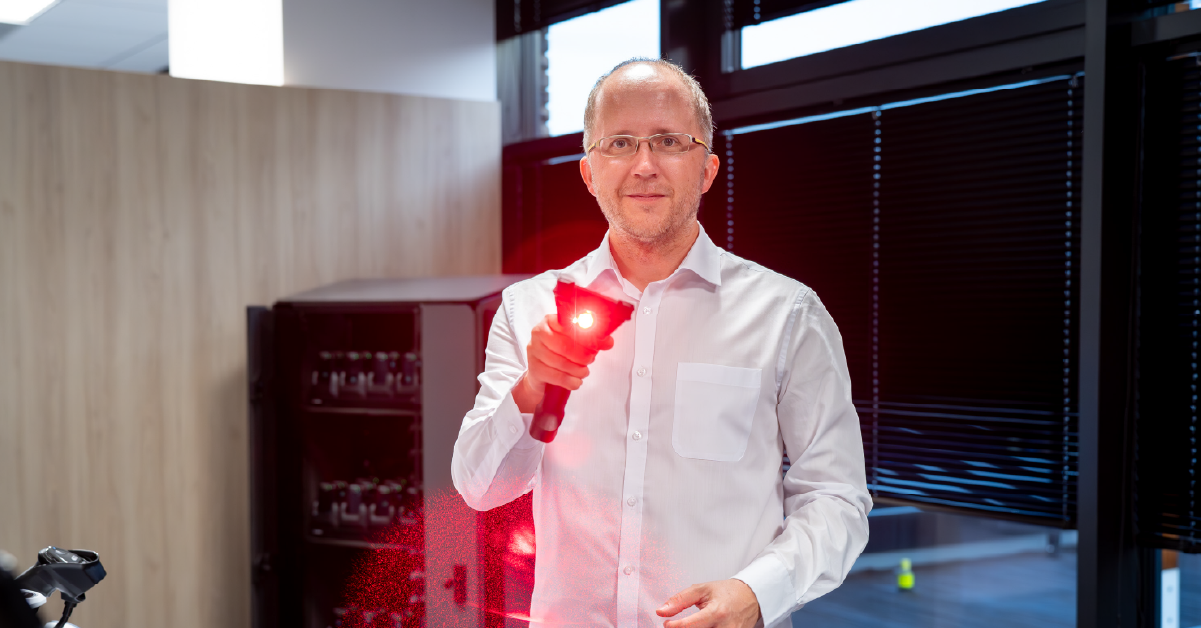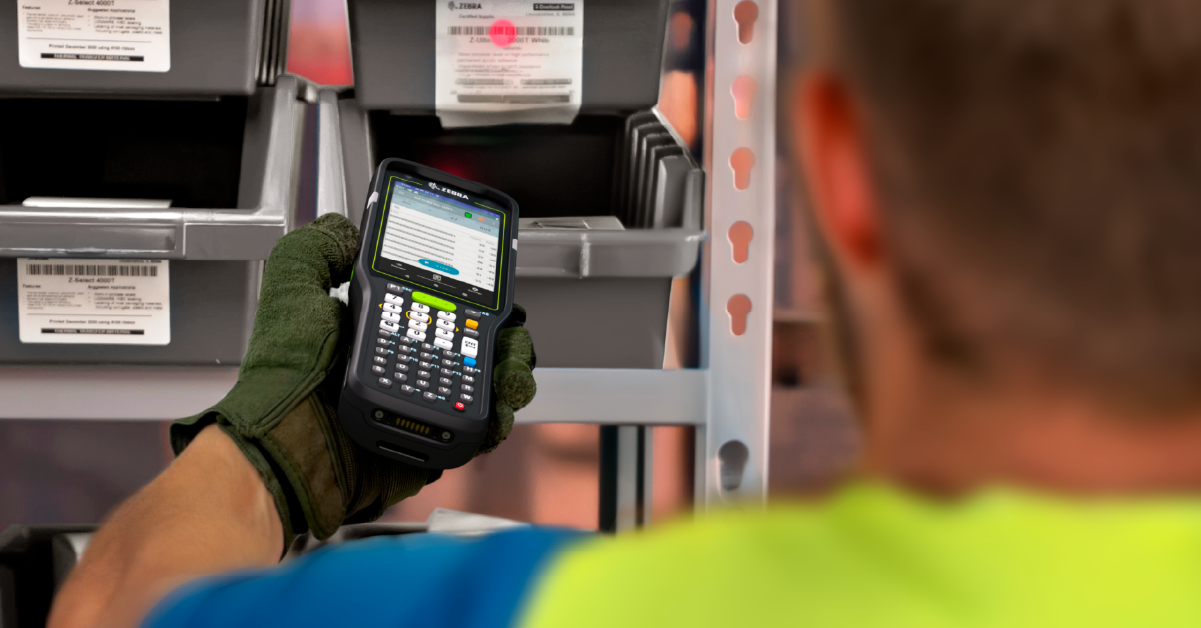
How can an upgrade done right save your operations? Aimtec’s Petr Stejskal has a clear answer.
- Technologies
- Interview
In our interview with Aimtec CTO Petr Stejskal, we look at lifecycle management, data security, the benefits of upgrading mobile terminals and more. See how mobile terminals are managed in manufacturing and logistics, with practical examples showing how a well-planned upgrade can make operations easier and more efficient – and the impact of form factor on hardware choices.
When it comes to outdated mobile terminals, what area is the most overlooked?
The usual “if it ain’t broke don’t fix it” approach often pushes one key aspect into the background: an updated and secure operating system. Every operating system developer gives their OS support for a limited period only, and running devices with systems for which regular security updates are not available can lead to heightened cybersecurity risks. Today’s increasing digitalisation brings benefits, but also risks that you need to address properly.
Where do you see the biggest benefit of modernising mobile devices for operators in manufacturing and logistics?
The main benefits can be grouped into two areas – greater efficiency and new possibilities. Today’s hardware brings users faster applications and wireless communication, and also a more pleasant user interface. Besides these, it opens up new possibilities such as taking pictures, connecting over 5G, AR/VR and harnessing modern AI technology.
Artificial intelligence is primarily used as a “buddy” that offers advice to newly trained operators and checks for abnormalities in processes.
Petr Stejskal, Chief Technology Officer, Aimtec
How can terminals’ life cycles be monitored and managed to limit unplanned downtime?
One key thing is to track several metrics that are critical yet often overlooked.
These include:
- Battery capacity and usability – batteries are consumables, and so in many cases degradation cuts their lifetimes down to a single shift or less. Operators then have to replace batteries several times per shift.
- The state of the operating system and applications – regular updates and monitoring of any problems (“ANR” – Application Not Responding states) prevent unexpected problems during use.
- Usage statistics – from scan counts to usage time to distributions among individual work centres, proper installed-base management is key for high efficiency of use.
How often do you see companies using devices right up to the very limits of their lifespans?
Some companies have regular replacement cycles set up, but some are managed primarily by way of new requirements, and so device replacement is connected, for example, with new customer projects. The important thing is to actively manage device lifespans from the very start of the lifecycle and integrate upgrade costs appropriately into your overall business plan.
From the information security standpoint – what do you see as the most critical weakness in mobile terminals?
Many security experts confirm that the user is the greatest risk. Modern Android-based devices offer advanced tools for keeping users’ work with devices fully under control and entirely compliant with a company’s security rules. So the user can be denied any access to device settings, app installation or any other data manipulation. The user can use approved company applications only, and so data processing is always entirely secure.
What’s your opinion on the role of artificial intelligence in logistics and manufacturing? Is it already a reality, or more a distant future? How do mobile terminals reflect the AI factor?
Artificial intelligence is primarily used as a “buddy” that offers advice to newly trained operators and checks for abnormalities in processes. Mobile terminals have to be prepared for the arrival of AI primarily in their processor performance and optimisation for running LLM models, as well as support for the latest applications.
What do you see as a frequent mistake managers make when deciding on investments in mobile technologies?
We often see decision-making based on one-off investment costs, with considerable pressure to minimise these. Total cost of ownership (TCO) is thus not always assessed over a period of at least five years (the typical lifecycle for high-quality industrial devices), which is when all cost components need to be taken into account. Such as servicing costs (which can be optimised or given upper limits through a service contract), costs for unexpected downtime and sometimes possible penalties for failure to meet delivery deadlines or the agreed scope.
What role does ease of use and employee satisfaction play when choosing new devices?
Studies show that employees highly value the quality of their equipment, and when they are given modern devices, they have far fewer reasons to switch jobs. This limits the negative impacts of employee churn while also reducing costs for employee onboarding.
If you had one tip to give to companies concerning upgrades to their mobile terminals, what would it be?
Develop a strategy together with a trustworthy and experienced partner and stick to it. The key thing here is a long-term vision that meets your company’s growth needs while also offering new opportunities such as the benefits of an independent, experienced partner.
Do you have an example of a situation where a mobile terminal upgrade fundamentally changed how an operation is run?
We migrated the ball-bearing supplier SKF from the no longer supported Windows Mobile platform to modern Android devices. Besides increasing operators’ productivity, this simultaneously gave management an overview of how devices are used, which can now be actively managed. Before the migration they often ran into “locker syndrome” (where most of the devices ended up locked away in operators’ lockers), causing a lack of devices in operation and a resulting productivity drop. The upgrade resolved all this.
What role does form factor play when choosing mobile terminals, and how do companies approach the ergonomics of working with them?
Form factor is a key parameter when choosing the right equipment for the right process. Individual form factors have their main benefits in specific processes, and because of this it’s wise, for example, to deploy wearable devices mainly for picking, or mobile terminals with long-range scanners in warehouse operations where operators pick directly from material-handling equipment.
Share article
Top stories from logistics, production and IT.
Subscribe to Aimtec Insights
By registering, you agree to the processing of your personal data by Aimtec as described in the Privacy policy.
Get top stories and articles
from Logistics, Production and IT.
Subscribe to Aimtec Insights
By registering, you agree to the processing of your personal data by Aimtec as described in the Privacy policy.