Digitalisation Doesn’t Work without People: How Safran Cabin Saved 75 Million Euros

Aimtec
21. 1. 2026
6 minutes reading
What is the cost of digitalisation when it isn't used in your operations? And what decides whether people will adopt a new tool, or bypass it with Excel instead? At the TAL 2025 conference, Selim Caluwaerts, Chief Data Officer and DigiMaps Program Director at Safran Cabin, explained that the key is not technology; it’s working with people, processes and data. And that skipping steps doesn't pay off!
Safran, the world’s third largest aerospace company, is active in 27 countries and employs over 100,000 people. This brings the classic challenges that are also faced by other major manufacturers:
- supply chain disruptions,
- a lack of qualified personnel,
- fragmented data and low data quality,
- differing levels of digital maturity across locations.
A systematic approach and four key steps helped Safran Cabin to achieve 75 million euros in savings last year. The DigiMaps system (Digital Manufacturing and Advanced Planning & Scheduling) accompanied Safran Cabin throughout this journey. DigiMaps covers the entire digitalisation plan, supply chain, cloud strategy and planning processes, including digital twins. Its implementation was overseen by a company-wide team of digitalisation specialists, led by Selim Caluwaerts, the company’s Chief Data Officer and DigiMaps Program Director. “As managers, we circled the planet eighteen times last year. If you’re seeking innovation and a path to high-quality digitalisation, you ;have to work through it with the people at all levels of your company and all its locations.”
Watch the presentation from the Trends in Automotive Logistics 2025 conference (only available in English):
Step one: people and good old-fashioned communication
Do your homework properly! Every plant in a company is different, as are the mindsets and habits of local employees. Do its people have the needed skills? Do they understand why the change is happening? If you don’t have the local team on your side, your project will only work while you’re at the plant. Once you’re gone, it’s over. It’s about trust, the ability to explain the big picture, and visiting your sites. A company that digitalises from its desks without real contact with operations risks its solutions being temporary and ineffective.
Step two: processes that have a real chance to survive
It's not enough to merely say how things should work. The key is to know what a real day at the plant looks like process-wise. Is everything set up to meet customer needs? Are the processes lean – or just historically ingrained? Are they applied consistently, or do they depend on a specific person?
Step three: data you could bet your salary on
Data is third priority – perhaps surprisingly low. Is it complete, accurate, correctly classified? Can it easily be exported and used in the cloud? And do you know who actually owns it?
Caluwaerts pointed out that data inconsistency and siloed information systems are among the biggest problems across the industry, not just at Safran Cabin. Tools like Aimtec Data Intelligence or Collibra can help you here. When your teams don’t trust your data, they will find a way to bypass the system. One typical and currently undesirable example is Excel.
Step four: tools tailored to specific locations
Technology only comes into play once a specific plant’s needs and digital maturity are clearly defined. Safran Cabin does not use a one-size-fits-all approach. It works with an entire ecosystem of solutions, assembled to suit each location’s needs.
The tools that are used include, for example:
- planning systems (Asprova APS),
- data management and quality platforms (Aimtec Data Intelligence, Collibra),
- production and simulation tools (AVIX, WIPSIM),
- cloud solutions (AWS).
To choose a tool, you have to understand the local reality. Only then will your users be willing to use the tools and place their trust in them instead of bypassing the official system.
If your people are overusing Excel, you need to figure out why. It’s possible they don’t trust your system and are trying to avoid it. And that has to be resolved.
AI in practice: a robot instead of the human eye
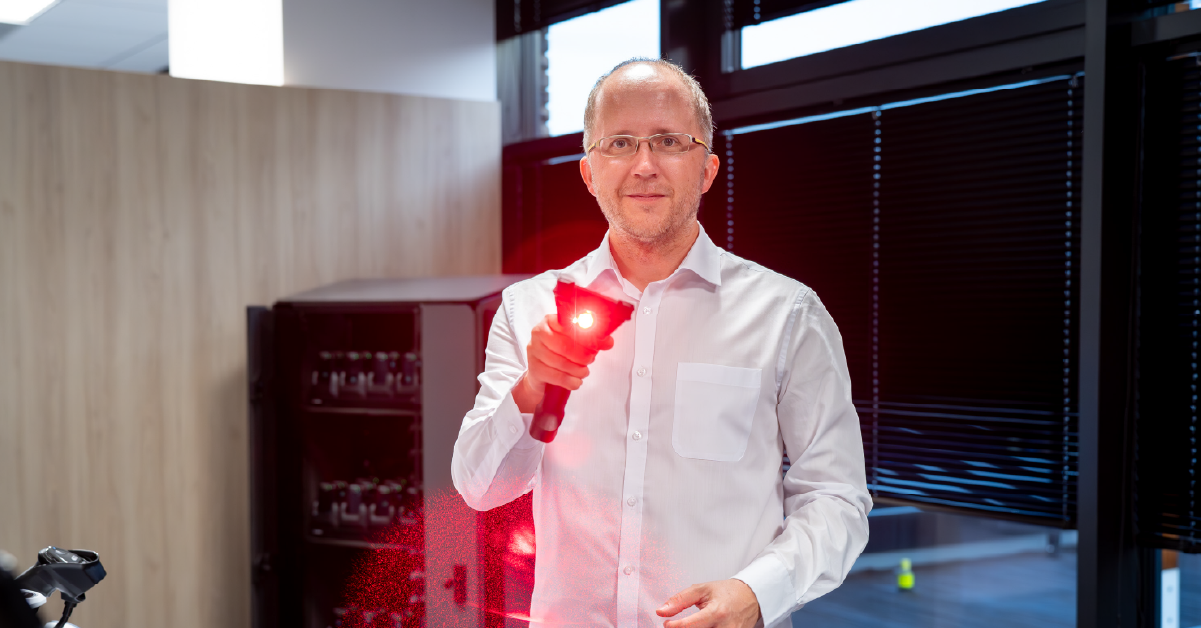
Where should you deploy AI to ensure it’s truly effective and beneficial? At Safran Cabin, they chose the visual inspection of painted parts. In aerospace manufacturing, even a microscopic bubble can cause surface cracking during flight. Manual visual inspection is extremely variable. An employee might approve something on Monday morning and flag it as a defect on Tuesday afternoon.
Safran Cabin has therefore implemented robotic inspection controlled by artificial intelligence. Each part is scanned from the same distance and at the same angle. However, the digitalisation team also encountered obstacles here. AI typically learns from thousands of images, but one specific aspect of aerospace is low production volume, which does not allow for learning this way. One crucial condition was the quality of the input data, as well as the involvement of key users who understand the system and know when to verify or correct the results.
The takeaway? Robots and AI ensure more consistent work – but they still need to be trained by an experienced person. The entire process is linear. It requires time and patience before it starts delivering results and real efficiency gains.
The experience from Safran Cabin: what really works
What has proven effective across all their operations? The DigiMaps implementation team repeatedly validated the following recommendations:
- Don’t push tools from the top down. Talk to your people, be there on-site, understand what things really look like, and optimise solutions accordingly.
- Don’t implement everything at once. Develop a stable core, verify it in operation, and only then scale it up.
- IT has to be a partner, not a service. Without its active support and resources, you can’t implement changes or maintain them.
Safran Cabin achieved savings of 75 million euros because it manages digitalisation as a process, not just piling up tools. Every step, from working with people to choosing the system, is tailored to individual plants’ specifics, yet it also consciously maintains a standard. Only in this way can you achieve digitalisation that’s sustainable and truly helpful for your teams.
Related stories