BMW iFACTORY: 36 Million Parts Each Day, One Digital System


Aimtec
4. 12. 2025
6 minutes reading
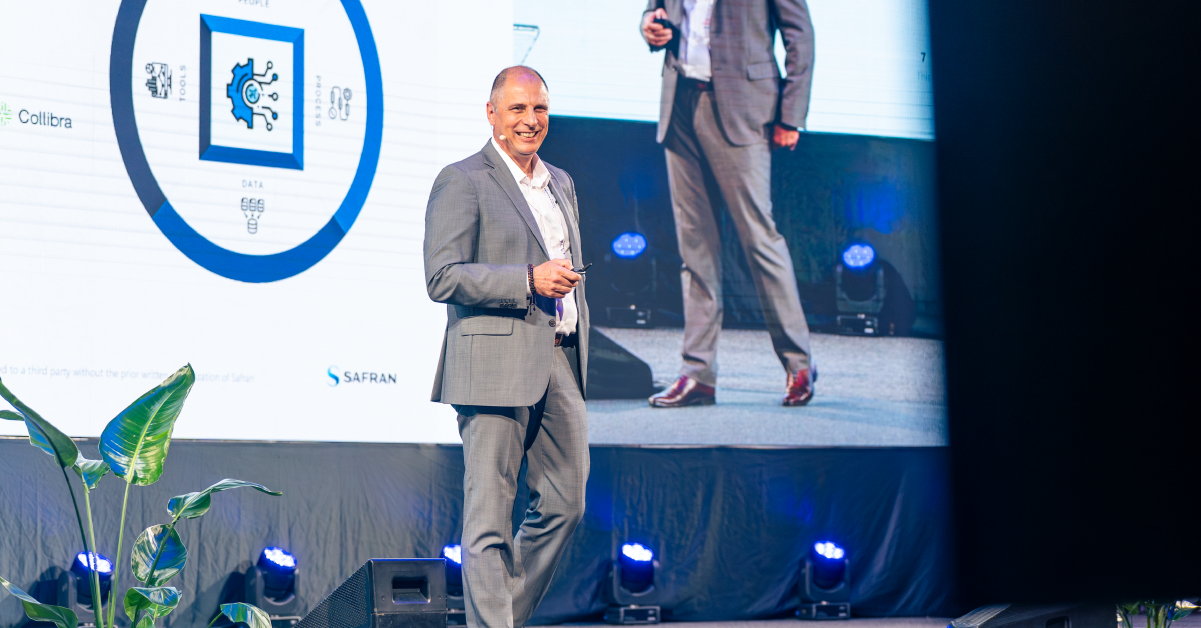
BMW Group is going through a fundamental transformation. Each of its thirty global manufacturing plants is gradually becoming an iFACTORY – a modern operation that’s effective, sustainable and digital. This is not a pilot project, but a shift in its global manufacturing system towards comprehensive and innovative thinking. Forever. At Trends in Automotive Logistics (TAL) 2025, Tobias Mayr, BMW Group’s General Manager IT Inbound Logistics, provided a behind-the-scenes look at this transformation.
Every year, BMW Group produces roughly 2.5 million cars and more than 200,000 motorcycles. Thirty plants around the world take part in producing this volume. Every day 36 million parts need to be moved from place to place, at the right time, in the right order, to the right place each time. All of this must rely on a superbly working network of suppliers – BMW has 4,000 of them – as well as reliable IT systems. For its bold step towards standardisation, digitalisation, and clearly defined processes, the BMW Group team chose a combination of SAP S/4HANA and its own services built on Microsoft Azure.
Let's digitalise - sustainably
BMW Group summarises its transformation philosophy into three pillars: efficiency, sustainability and digitalisation. Efficiency comes first, for a very clear reason. “A bad process stays bad even after digitalisation,” emphasises Mayr. Processes need to be optimised first; only then is there any point in digitalising them. Sustainability includes circularity, reduced resource use and social aspects. Digitalisation brings greater speed, efficiency and quality – all undeniable arguments in favour of increased investment in the digital transformation.
Watch Tobias Mayr's presentation from the Trends in Automotive Logistics 2025 conference (only available in German):
First fossil-free factory
The focus on sustainability is fully reflected at the new plant in Debrecen, Hungary. It will be the first automotive factory in the world to entirely abandon fossil fuels in manufacturing. This year, the production of Neue Klasse electric cars will begin here, making this plant a model for sustainable production. A significant portion of the energy needed will be generated directly on-site, while 100% renewable sources, primarily from regional suppliers, will cover the rest. As Milan Nedeljković, the BMW AG board member responsible for production, puts it: “Environmental, economic and social responsibility are inseparable from each other – we try to connect all three areas both in the product itself and throughout the value chain. Our goal is an 80% reduction in CO2 by 2030 compared to 2019.” He states that the transition to renewable sources has not just an environmental but also a social impact – it helps to stabilise energy prices and provide security of supply within the region.
A bad process stays bad even after digitalisation. Processes need to be optimised first; only then is there any point in digitalising them
Tobias Mayr, General Manager IT Inbound Logistics, BMW Group
Aiming towards a unified platform
The innovative iFACTORY concept is also a response to the increased need for flexibility in automotive. Without unified and verified processes, the costs for managing systems are so high that they hurt innovation more than they help. The decisive impulse for the globally-shared logistics templates came from the 2018 announcement that support for SAP R/3 would be ending in 2030. BMW Group therefore launched its Prozesskette Teile (PKT) project, whose goal is to transition to SAP S/4HANA and create a unified template for the whole world.
The goals of BMW Group's unified manufacturing template
- A single shared template in every manufacturing plant worldwide.
- End-to-end data integration; all of the technology will be centrally accessible.
- Cloud-first, complete abandonment of on-premise.
“Wherever we can use the basic features in SAP, we’re staying with SAP. We’re developing specific features for BMW Group ourselves as services running on Microsoft Azure,” says Mayr. All this significantly reduces the difficulty of testing when releasing new versions and updating SAP. A total of 31 IT teams is engaged in the single-template project; they are preparing an environment for 50,000 end users.
Roll-out in practice: Restricting production? Forget it!
How did the BMW Group team approach the template’s gradual roll-out? “We started with the automotive manufacturing plants, and only then moved on to the plants for producing components – and we’ll get to overseas logistics at the end,” said Mayr. At present the template is in use at four plants. The first was the Mini plant in the British city of Oxford, followed by the revolutionary plant in Debrecen, Hungary, which operates entirely without fossil fuels. In 2025 these were followed by the plant in Regensburg, Germany and the main plant in Munich.
The real trial by fire was the roll-out in Regensburg. That plant operates on a three-shift basis, and so production cannot be restricted in any way. The original plan counted on the plant running single-shift for one week, then adding a second shift and going to full three-shift operation only after three weeks. But in the end, the implementation team received only two days of restricted operation; all the shifts had to be running by the third day. “The plan was aggressive; we knew about the risks, but we had to succeed. And we did,” summarises Mayr. The roll-out went faster than expected, and it brought greater efficiency too.
Every future implementation will improve the template. A roll-out in Mexico’s San Luis Potosí plant will follow, and the first services should soon be ramping up in China as well, which will present entirely new challenges.
The key to success? Business and IT hand in hand.
Tobias Mayr’s recommendation is clear – tight cooperation between IT and business. Both departments operate in an agile, sprint-based mode and function as a single team. “Business is IT and IT is business” – that is how Mayr describes the approach that has enabled BMW Group to uplift digitalisation from a technical project to the strategic level company-wide.
The BMW iFACTORY shows that digitalisation is not a goal, but a tool. The automaker first builds lean, sustainable processes and only then builds digital processes based upon them. The unified platform within SAP, supplemented by custom cloud applications, enables BMW Group to manage logistics end-to-end, standardise processes with thousands of suppliers and prepare itself for the future.

Get top stories from logistics, production and IT.
By registering, you agree to the processing of your personal data by Aimtec as described in the Privacy policy.
Related stories